Java 4种将数组元素复制到另一个数组中
AI 摘要鱼粮不足,AI 今天先歇着 · 正文在下面
前言
最近有同学刚学 Java,问我有没有快速复制数组的方法,于是,我就想着写篇小结给他参考下。
1、直接共享一个地址
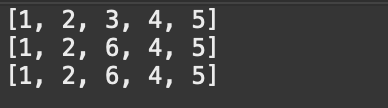
这相当于 c 语言中地址传递,相当于把新数组的地址指向原来数组的地址,两个数组共享一个地址。
java
import java.util.Arrays;

public class Main {

	public static void main(String[] args) {
		int[] arr = { 1, 2, 3, 4, 5 }; // 原数组
		int[] arr1 = arr; // 要复制的数组
		System.out.println(Arrays.toString(arr1));

		// 我们修改复制数组的元素
		arr1[2] = 6;
		// 查看两个数组的值是否都发生变化
		System.out.println(Arrays.toString(arr));
		System.out.println(Arrays.toString(arr1));
	}
}看看结果,可以看到两个数组的元素都修改了
2、遍历赋值
利用循环为新数组对应下标位置的元素赋值上旧数组对应下标的元素。
java
import java.util.Arrays;

public class Main {

	public static void main(String[] args) {
		int[] arr = { 1, 2, 3, 4, 5 }; // 原数组
		int[] arr2 = new int[arr.length]; // 新数组,开辟一个跟arr一样的长度的空间;
		for (int i = 0; i < arr.length; i++) {
			arr2[i] = arr[i]; // 依次遍历赋值
		}
		System.out.println(Arrays.toString(arr2));
	}
}
3、Object.clone()方法
它是 Object 的一个原生方法,源码如下:
java
    /**
     * Creates and returns a copy of this object.  The precise meaning
     * of "copy" may depend on the class of the object. The general
     * intent is that, for any object {@code x}, the expression:
     * <blockquote>
     * <pre>
     * x.clone() != x</pre></blockquote>
     * will be true, and that the expression:
     * <blockquote>
     * <pre>
     * x.clone().getClass() == x.getClass()</pre></blockquote>
     * will be {@code true}, but these are not absolute requirements.
     * While it is typically the case that:
     * <blockquote>
     * <pre>
     * x.clone().equals(x)</pre></blockquote>
     * will be {@code true}, this is not an absolute requirement.
     * <p>
     * By convention, the returned object should be obtained by calling
     * {@code super.clone}.  If a class and all of its superclasses (except
     * {@code Object}) obey this convention, it will be the case that
     * {@code x.clone().getClass() == x.getClass()}.
     * <p>
     * By convention, the object returned by this method should be independent
     * of this object (which is being cloned).  To achieve this independence,
     * it may be necessary to modify one or more fields of the object returned
     * by {@code super.clone} before returning it.  Typically, this means
     * copying any mutable objects that comprise the internal "deep structure"
     * of the object being cloned and replacing the references to these
     * objects with references to the copies.  If a class contains only
     * primitive fields or references to immutable objects, then it is usually
     * the case that no fields in the object returned by {@code super.clone}
     * need to be modified.
     * <p>
     * The method {@code clone} for class {@code Object} performs a
     * specific cloning operation. First, if the class of this object does
     * not implement the interface {@code Cloneable}, then a
     * {@code CloneNotSupportedException} is thrown. Note that all arrays
     * are considered to implement the interface {@code Cloneable} and that
     * the return type of the {@code clone} method of an array type {@code T[]}
     * is {@code T[]} where T is any reference or primitive type.
     * Otherwise, this method creates a new instance of the class of this
     * object and initializes all its fields with exactly the contents of
     * the corresponding fields of this object, as if by assignment; the
     * contents of the fields are not themselves cloned. Thus, this method
     * performs a "shallow copy" of this object, not a "deep copy" operation.
     * <p>
     * The class {@code Object} does not itself implement the interface
     * {@code Cloneable}, so calling the {@code clone} method on an object
     * whose class is {@code Object} will result in throwing an
     * exception at run time.
     *
     * @return     a clone of this instance.
     * @throws  CloneNotSupportedException  if the object's class does not
     *               support the {@code Cloneable} interface. Subclasses
     *               that override the {@code clone} method can also
     *               throw this exception to indicate that an instance cannot
     *               be cloned.
     * @see java.lang.Cloneable
     */
protected native Object clone() throws CloneNotSupportedException;可以看到要能使用这个方法,需要实现 Cloneable 接口,而数组继承了 Object 类,又实现了接口 Cloneable 与 java.io.Serializable,故可以使用 clone() 方法。
java
import java.util.Arrays;

public class Main {

	public static void main(String[] args) {
		int[] arr = { 1, 2, 3, 4, 5 }; // 原数组
		int[] arr3;
		arr3 = arr.clone();
		System.out.println(Arrays.toString(arr3));
	}
}
4、System.arraycopy()方法
它是 System 类提供的原生方法,源码如下:
java
    /**
     * Copies an array from the specified source array, beginning at the
     * specified position, to the specified position of the destination array.
     * A subsequence of array components are copied from the source
     * array referenced by <code>src</code> to the destination array
     * referenced by <code>dest</code>. The number of components copied is
     * equal to the <code>length</code> argument. The components at
     * positions <code>srcPos</code> through
     * <code>srcPos+length-1</code> in the source array are copied into
     * positions <code>destPos</code> through
     * <code>destPos+length-1</code>, respectively, of the destination
     * array.
     * <p>
     * If the <code>src</code> and <code>dest</code> arguments refer to the
     * same array object, then the copying is performed as if the
     * components at positions <code>srcPos</code> through
     * <code>srcPos+length-1</code> were first copied to a temporary
     * array with <code>length</code> components and then the contents of
     * the temporary array were copied into positions
     * <code>destPos</code> through <code>destPos+length-1</code> of the
     * destination array.
     * <p>
     * If <code>dest</code> is <code>null</code>, then a
     * <code>NullPointerException</code> is thrown.
     * <p>
     * If <code>src</code> is <code>null</code>, then a
     * <code>NullPointerException</code> is thrown and the destination
     * array is not modified.
     * <p>
     * Otherwise, if any of the following is true, an
     * <code>ArrayStoreException</code> is thrown and the destination is
     * not modified:
     * <ul>
     * <li>The <code>src</code> argument refers to an object that is not an
     *     array.
     * <li>The <code>dest</code> argument refers to an object that is not an
     *     array.
     * <li>The <code>src</code> argument and <code>dest</code> argument refer
     *     to arrays whose component types are different primitive types.
     * <li>The <code>src</code> argument refers to an array with a primitive
     *    component type and the <code>dest</code> argument refers to an array
     *     with a reference component type.
     * <li>The <code>src</code> argument refers to an array with a reference
     *    component type and the <code>dest</code> argument refers to an array
     *     with a primitive component type.
     * </ul>
     * <p>
     * Otherwise, if any of the following is true, an
     * <code>IndexOutOfBoundsException</code> is
     * thrown and the destination is not modified:
     * <ul>
     * <li>The <code>srcPos</code> argument is negative.
     * <li>The <code>destPos</code> argument is negative.
     * <li>The <code>length</code> argument is negative.
     * <li><code>srcPos+length</code> is greater than
     *     <code>src.length</code>, the length of the source array.
     * <li><code>destPos+length</code> is greater than
     *     <code>dest.length</code>, the length of the destination array.
     * </ul>
     * <p>
     * Otherwise, if any actual component of the source array from
     * position <code>srcPos</code> through
     * <code>srcPos+length-1</code> cannot be converted to the component
     * type of the destination array by assignment conversion, an
     * <code>ArrayStoreException</code> is thrown. In this case, let
     * <b><i>k</i></b> be the smallest nonnegative integer less than
     * length such that <code>src[srcPos+</code><i>k</i><code>]</code>
     * cannot be converted to the component type of the destination
     * array; when the exception is thrown, source array components from
     * positions <code>srcPos</code> through
     * <code>srcPos+</code><i>k</i><code>-1</code>
     * will already have been copied to destination array positions
     * <code>destPos</code> through
     * <code>destPos+</code><i>k</I><code>-1</code> and no other
     * positions of the destination array will have been modified.
     * (Because of the restrictions already itemized, this
     * paragraph effectively applies only to the situation where both
     * arrays have component types that are reference types.)
     *
     * @param      src      the source array.
     * @param      srcPos   starting position in the source array.
     * @param      dest     the destination array.
     * @param      destPos  starting position in the destination data.
     * @param      length   the number of array elements to be copied.
     * @exception  IndexOutOfBoundsException  if copying would cause
     *               access of data outside array bounds.
     * @exception  ArrayStoreException  if an element in the <code>src</code>
     *               array could not be stored into the <code>dest</code> array
     *               because of a type mismatch.
     * @exception  NullPointerException if either <code>src</code> or
     *               <code>dest</code> is <code>null</code>.
     */
    public static native void arraycopy(Object src,  int  srcPos,
                                        Object dest, int destPos,
int length);该方法需要几个参数:原数组,原数组的其实下标,目标数组,目标数组的起始下标,要拷贝的元素数量。
java
import java.util.Arrays;

public class Main {

	public static void main(String[] args) {
		int[] arr = { 1, 2, 3, 4, 5 }; // 原数组
		int[] arr4 = new int[arr.length]; // 新数组

		// 将arr从0下标开始长度为arr.length的元素复制给arr4从0开始长度为arr.length的元素
		System.arraycopy(arr, 0, arr4, 0, arr.length);
		System.out.println(Arrays.toString(arr4));
	}
}评论
0 条—
还没有评论,来说第一句